

Digital Land Pattas For Tea Garden Workers: Land Reform, Assam Politics, Election Dynamics & Application Guide
 TheAdivasisApril 16, 202619 Mins read74
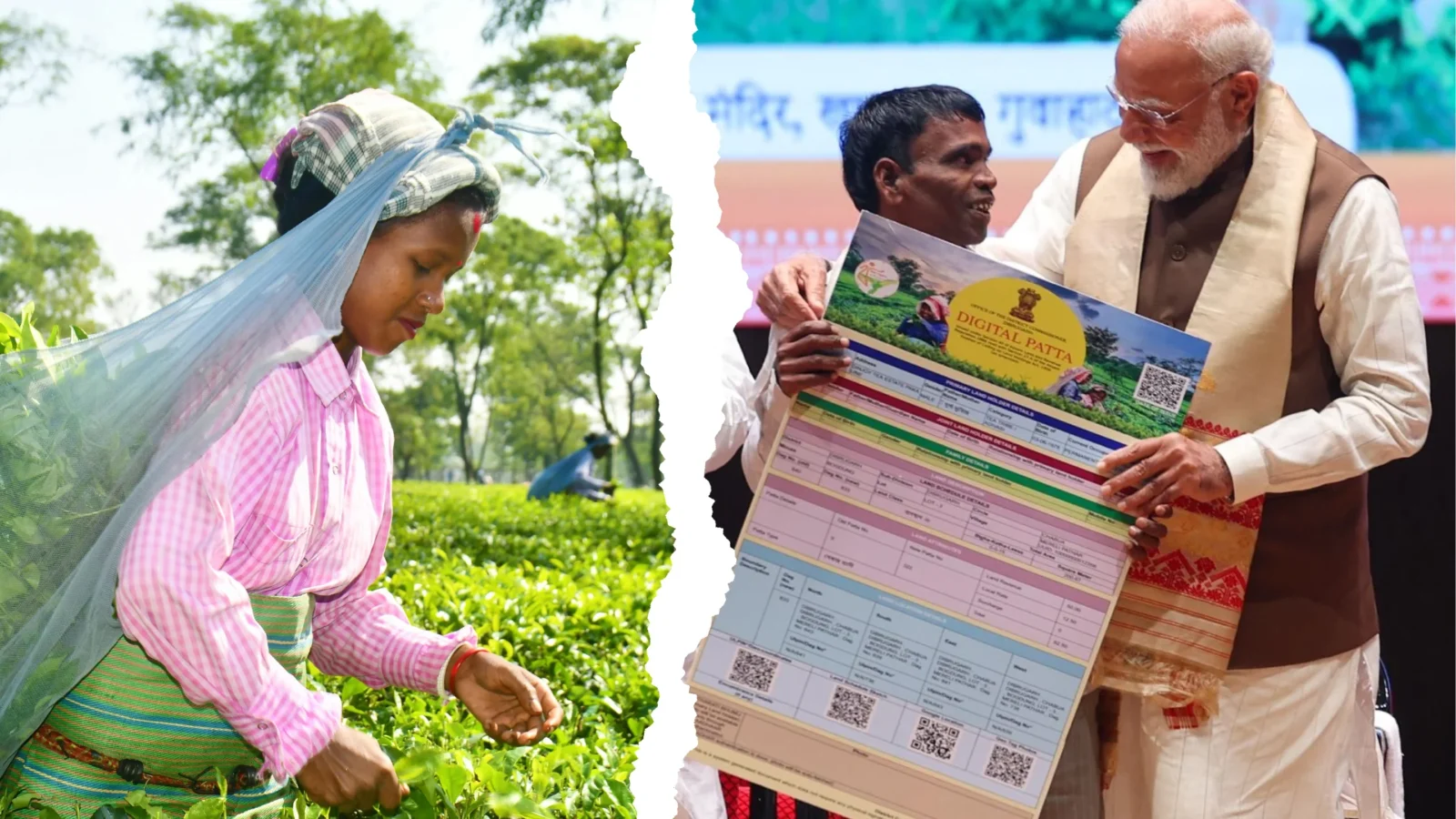
Digital Land Patta: Assam’s tea industry, among the world’s oldest and most iconic, has for nearly two centuries depended on the labour of millions of workers whose ancestors were brought from the Chotanagpur plateau of central India — present-day Jharkhand, Odisha, Chhattisgarh, and Bihar — by British colonial planters as indentured labour from the mid-nineteenth century onwards. These communities settled in ‘labour lines’ within the estate boundaries and built entire self-contained societies — with their cultural practices, festivals, dialects, and customs — without ever acquiring legal ownership over the land on which their homes stood. Their residences were company property; their tenure was contingent (subject to change); and their identity as Assamese citizens was, for long, structurally marginal.
This fundamental inequity — persisting for over 200 years — was formally addressed when the Assam Legislative Assembly passed the Assam Fixation of Ceiling on Land Holdings (Amendment) Bill, 2025 on November 28, 2025.
The landmark legislation enabled more than 3.33 lakh tea garden worker families to receive legal land ownership rights over the homestead plots on which their homes stand. Chief Minister Himanta Biswa Sarma described it as one of the most significant land reforms in post-independence Assam. An important legal protection inserted into the amendment is that land allotted under the scheme cannot be sold or transferred for a period of 20 years, and after that period, any sale will be permitted only to residents of the same tea garden area — protecting the community from land sharks, speculative buyers, and displacement by commercial interests.
PM Modi- Land Patta Distribution
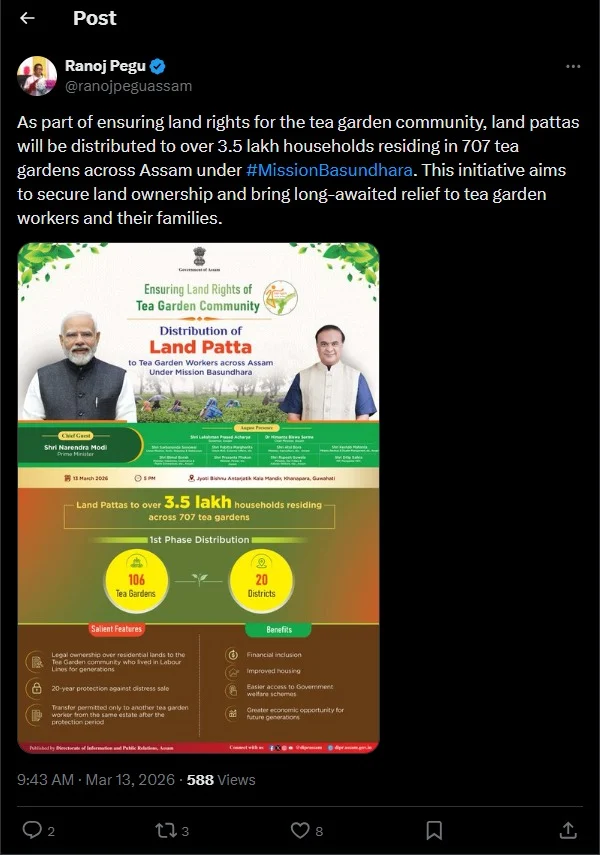
The formal launch of digital patta distribution took place on March 13, 2026, when Prime Minister Narendra Modi ceremonially handed over land ownership certificates to tea garden workers at the Jyoti Bishnu Antarjatik Kala Mandir, Khanapara, Guwahati. PM Modi distributed pattas to 28,241 families across 825 tea gardens in Phase 1. Describing the initiative as ‘ending a historic injustice,‘ the Prime Minister connected the occasion to his personal history as a former tea seller.
Legislative and Policy Framework
i. The Amendment Bill, 2025 — The Core Legal Instrument
The passage of the Assam Fixation of Ceiling on Land Holdings (Amendment) Bill, 2025 on November 28, 2025 was the cornerstone legal instrument enabling the patta distribution programme. The Assam government declared a holiday for ‘Assam tea industry workforce’ to watch the news of the landmark passing of the Act in the Assembly. Before the amendment, tea garden land had been held under long-term leases granted to plantation companies under special colonial-era provisions, which prevented workers residing on labour line land from claiming individual ownership.
What were the inserted sections in the Act?
a. The amendment inserted a new Section 7A into the Act:
“Acquisition of Lands under Labor Lines-
i). The State Govt. shall acquire lands under labor lines in such a manner as may be prescribed and all rights, title, interest and encumbrances of such acquired lands shall be vested in the Government and the persons affected for the acquisitions of lands under labour lines, shall be entitled for compensation, as may be determined by the Government under section of 12 of this Act: Provided that, such acquired lands may also be disposed by the Government in such manner as may be prescribed under section 17 of this Act.”
b. Insertion of Section 17 A
“Manner of disposal of land acquired under 7 A –
1). Notwithstanding anything contained in section 17 of this Act or any other law for the time being in force, the Government after, acquiring lands in labour lines under section 7A, give settlement of such lands to tea garden workers residing and in occupation of such lands;
2). Notwithstanding anything contained in this act or any other law for the time being in force or in any instrument having effect by virtue of any law other than this Act, such lands acquired under section 7A shall be heritable, but shall remain non-transferable by way of sale, lease, gift or any other form of alienation for 20 years or as notified by the Government from time to time:
3). The sale, transfer, lease, gift or alienation of such land after the expiry of the period of 20 years or as notified by the Government from time to time, shall be permissible only in favor of a tea garden worker as defined in the Act and residing in the same tea estate.
4).The Government may issue notification, frame conditions regarding the extent of disposal of such lands, for utility and optimal usage of such lands for the welfare of the tea garden worker, in the manner as may be prescribed.
5).The extent of land, per family of a tea garden worker, to be settled shall be such, as may be notified by the Government from time to time. (Source: The Assam Gazette, Extraordinary, December 10, 2025)
Approximately 3.33 lakh eligible “tea worker” families across Assam are to receive pattas covering approximately 2.18 lakh bighas of land in total, expected to benefit over 14.5 lakh family members. The 20-year non-transferability clause and the restriction (Section 17 A) of subsequent sales to residents within the same tea garden area were included to prevent commercial exploitation of newly landed workers.
However, civil society organisations and human rights bodies have raised concerns about implementation gaps in the Act itself. Critics have noted that the Act does not specify, “who within a family holds the title — raising questions about whether women, who form the majority of the tea workforce, will be named as owners or joint holders”.
In the absence of comprehensive social mapping or beneficiary census, there are also concerns about discrimination during settlement due to power imbalances within the heterogeneous tea worker community, which includes permanent, temporary, and descendants of former workers.
Distribution Data — District-wise and Estate-wise
i. Phase 1 Launch — March 13, 2026
The central ceremony on March 13, 2026 at Khanapara, Guwahati, marked the first formal state-wide distribution of digital land ownership certificates. In Phase 1, a total of 28,241 families received digital pattas. Distribution events were simultaneously organised across the state at individual garden locations, with livestreaming of the Guwahati programme. The scale and simultaneous coordination of the programme was described as unprecedented in Assam’s administrative history.
ii. Form Distribution — The Preparatory Phase (February 2026)
Prior to the March 13 digital patta distribution, the Assam government launched a district-wide application form distribution drive beginning February 10, 2026, from Dinjoy Tea Estate in Chabua, Dibrugarh — the first such event in the state. In Jorhat alone, 37,133 forms were distributed on February 11, 2026, to tea garden workers across 84 tea estates — making it one of the largest single-district beneficiary outreach exercises in the programme. In Darrang, 981 forms were distributed across 6 tea estates on the same day. In Morigaon, forms were also distributed on February 11. The total number of forms distributed in this phase across the state runs into hundreds of thousands, with Tinsukia, Dibrugarh, Sivasagar, and Barak Valley districts all in active preparatory phases.
The following table presents estate-level and district-level data as reported by credible media sources and official statements:
| Sl. No. | Name of Tea Estate | District | Constituency (LAC) | No. of Beneficiaries | Source |
|---|---|---|---|---|---|
| 1 | Dibrudarang Tea Estate | Sonitpur | Dhekiajuli | 695 | Assam Tribune, Feb 11, 2026 |
| 2 | Borsola Tea Estate | Sonitpur | Dhekiajuli | 177 | Assam Tribune, Feb 11, 2026 |
| 3 | Belsiri Tea Estate | Sonitpur | Barchalla | 501 | Sentinel Assam, Mar 15, 2026 |
| 4 | Noorbari Tea Estate | Sonitpur | Tezpur | 163 | Sentinel Assam, Mar 15, 2026 |
| 5 | Harchura Tea Estate | Sonitpur | Rangapara | 799 | Sentinel Assam, Mar 15, 2026 |
| 6 | Tupia Tea Estate | Sonitpur | Naduar | 11 | Sentinel Assam, Mar 15, 2026 |
| 7 | Cinnamara Tea Estate | Jorhat | Mariani | Part of 37,133* | Assam Tribune, Feb 11, 2026 |
| 8 | Teok Tea Estate | Jorhat | Titabor | Part of 37,133* | Assam Tribune, Feb 11, 2026 |
| 9 | Kusum Tea Estate | Jorhat | Jorhat East | Part of 37,133* | Assam Tribune, Feb 11, 2026 |
| 10 | Boloma Tea Estate | Jorhat | Jorhat West | Part of 37,133* | Assam Tribune, Feb 11, 2026 |
| 11–84 | 80 Other Tea Estates (Jorhat District) | Jorhat | Multiple LACs | Part of 37,133* | Assam Tribune, Feb 11, 2026 |
| 85 | Bokakhat Tea Estate | Golaghat | Bokakhat | Part of 2,931** | Sentinel Assam, Mar 15, 2026 |
| 86 | Rangamati Tea Estate | Golaghat | Bokakhat / Khumtai | Part of 2,931** | Sentinel Assam, Mar 15, 2026 |
| 87 | Rangajan Tea Estate | Golaghat | Golaghat / Sarupathar | Part of 2,931** | Sentinel Assam, Mar 15, 2026 |
| 88 | Doyang Tea Estate | Golaghat | Khumtai / Golaghat | Part of 2,931** | Sentinel Assam, Mar 15, 2026 |
| 89–95 | 7 Other Tea Estates (Golaghat District) | Golaghat | Multiple LACs | Part of 2,931** | Sentinel Assam, Mar 15, 2026 |
| 96 | Dinjoy Tea Estate (Launch Site) | Dibrugarh | Chabua | ~40 (ceremonial) | Assam Tribune, Mar 15, 2026 |
| 97 | Kopati Tea Garden | Darrang | Mangaldai | Part of 981*** | Assam Tribune, Feb 11, 2026 |
| 98 | Borgorah Tea Garden | Darrang | Mangaldai | Part of 981*** | Assam Tribune, Feb 11, 2026 |
| 99 | Chikonmati Tea Garden | Darrang | Mangaldai / Kharupetia | Part of 981*** | Assam Tribune, Feb 11, 2026 |
| 100 | Singimari Tea Garden | Darrang | Mangaldai | Part of 981*** | Assam Tribune, Feb 11, 2026 |
| 101 | Tongani (Pub-Mangaldai) Tea Estate | Darrang | Mangaldai | Part of 981*** | Assam Tribune, Feb 11, 2026 |
| 102 | Tongani (Banglagorh) Tea Estate | Darrang | Kharupetia | Part of 981*** | Assam Tribune, Feb 11, 2026 |
| 103 | Birjhora Tea Garden | Bongaigaon | Bongaigaon | Forms distributed Feb 9 | Sentinel Assam, Feb 8, 2026 |
| Sonitpur District Total (Phase 1, 6 estates): | 2,346 | Sentinel Assam, Mar 15, 2026 | |||
| Jorhat District Total (Phase 1, 84 estates — forms distributed): | 37,133 forms | Assam Tribune, Feb 11, 2026 | |||
| Golaghat District Total (Phase 1, 11 estates): | 2,931 pattas | Sentinel Assam, Mar 15, 2026 | |||
| Darrang District Total (Phase 1, 6 estates — forms distributed): | 981 forms | Assam Tribune, Feb 11, 2026 | |||
| Phase 1 State-wide (28 March 13, 2026 — digital patta distribution): | 28,241 families | PMO India | |||
| Full Programme Target (All Phases — 825+ estates, 27 districts): | 3,33,000+ families | Assam Leg. Assembly, Nov 28, 2025 | |||
Notes: * Jorhat: 37,133 forms distributed across 84 estates on Feb 11, 2026 — these are application forms, not yet final digital pattas. The four named estates are programme venues identified in reports. ** Golaghat: 2,931 digital pattas distributed in Phase 1 across 11 estates; individual estate breakdown not published. *** Darrang: 981 forms distributed across 6 estates on Feb 11, 2026. (Not an Exhaustive Data. Numbers may differ from actual figures.)
How to Apply for a Land Patta as a Tea Garden Worker?
The ambiguity and uncertainty of the application process has been a major topic for debates among the tea working community. However, as available on public domain, the application process for the Settlement of Labour Line Land for Tea Garden Workers is managed by the Assam Revenue and Disaster Management Department through the Sewa Setu portal (sewasetu.assam.gov.in) and through offline channels via Public Facilitation Centres (PFCs) and Common Service Centres (CSCs). Below is a comprehensive, step-by-step guide:
| Official Portal:- 1. Sewa Setu, Government of Assam: https://sewasetu.assam.gov.in/site/service-apply/settlement-of-labour-line-land-for-tea-garden-workers 2. Revenue & DM Department: https://landrevenue.assam.gov.in 3. Mission Basundhara: https://basundhara.assam.gov.in |
a. Eligibility Criteria
Below are the criteria as mentioned on Sewa Setu:
- You must be a permanent resident of Assam currently living in the labour line quarters of a registered tea estate.
- You must be a registered tea garden worker (permanent or long-term occupant) or a legal heir/descendant of such a worker currently residing on the labour line land.
- You must currently be in physical possession and occupation of the homestead plot on which you are applying.
- Management staff, tea garden owners, and those not residing on labour line land are not eligible.
- In case the original occupant has passed away, the legal heir residing on the land may apply with supporting inheritance documents.
- Women workers and female heads of household are encouraged to apply; the government has emphasised that women will be included as title holders.
b. Documents Required
Based on Sewa Setu portal guidelines and Revenue Department directions, applicants are expected to provide the following documents. Note: District administrations have directed that forms be filled carefully, and workers should not pay money to middlemen for this process.
• Voter ID Card (as supporting address proof and citizenship verification)
• Aadhaar Card (mandatory — required for Aadhaar-seeded land record and direct benefit transfer linkage)
• Employment Certificate or Identity Card issued by the tea estate management, confirming your status as a registered worker
• Address proof confirming residence in labour line quarters (employer letter, ration card, or utility document acceptable)
• Bank account details — must be linked to Aadhaar for direct benefit transfers under complementary schemes
• Photograph (passport-size, recent)
• Legal heir document (only if the original allottee/occupant has passed away and heir is applying)
• Dag Number / Plot details of the labour line land(to be obtained from the tea estate management or revenue circle office)
• Form filled under Mission Basundhara 3.0 / Sewa Setu — to be submitted as directed by the estate-level committee or District Administration
c. Step-by-Step Application Process
The application process runs through two parallel channels — the government-managed garden-level committee system (primary) and the Sewa Setu online portal (for follow-up and status tracking). Here is how the process works:
| Step 1 | Collect the Official Form: Application forms are being distributed through your tea estate management and through local government events organised by the District Administration and Revenue Circle offices. You do not need to print or arrange the form yourself — come to the distribution event or collect from the estate office. |
| Step 2 | Fill the Form Carefully: Fill the form with accurate personal details, Aadhaar number, bank account number, and land details (Dag No., labour line quarter number). The District Collector of Darrang specifically advised workers to ‘fill up the application forms carefully and submit them within the stipulated time.’ |
| Step 3 | Submit to the Garden-Level Committee: Each tea estate has a garden-level committee constituted to supervise beneficiary identification and allotment. Submit your completed form to this committee along with all required documents. Do not pay any money to anyone — the entire process is free of charge. |
| Step 4 | Verification by Revenue Circle Officer: The Revenue Circle Officer (RCO) for your area will verify your form, check land records, and confirm your physical possession of the plot. Be available for field verification if the revenue official visits the estate. |
| Step 5 | District Level Scrutiny and Approval: Your application goes to the District Level Implementation Committee (DLIC) for review. DLIC either approves or flags the application for clarification. |
| Step 6 | Online Portal — Sewa Setu (Optional/Tracking): You can also apply or track your application online at sewasetu.assam.gov.in. Register using your mobile number (OTP-based), log in, and navigate to ‘Settlement of Labour Line Land for Tea Garden Workers’ under the land services section. |
| Step 7 | Aadhaar Seeding and Record Creation: Once approved, your Aadhaar and ULPIN (Unique Land Parcel Identification Number) are seeded into the land record system, and the digital patta is generated with drone-imagery-verified boundaries. |
| Step 8 | Digital Patta Issuance: The digital patta is issued and notified via SMS and email. You can download the digital certificate from the Sewa Setu / ARTPS portal. A physical copy can be printed at a PFC/CSC at a nominal printing charge of Rs 10 per page (scanning charge Rs 5 per page; service charge Rs 30 through CSC). |
| Step 9 | Post-Patta: Housing Scheme Registration: Once you have your patta, register for the state government’s dedicated Tea Garden Worker Housing Scheme (under preparation), and ensure your name is updated in the PMAY (PM Awas Yojana) records for housing assistance eligibility. |
Note: You are advised to re-confirm the application process with the District Administration.
| IMPORTANT CAUTION: District administrations across Assam have issued specific warnings against middlemen and touts who may approach tea garden workers claiming to assist with patta applications in exchange for money. The entire process is FREE. If anyone demands payment, immediately report to the District Collector’s office or the Revenue Circle Officer. No fees are payable at any stage of the application. |
Important Phone Numbers and Help Contacts
• Sewa Setu Helpline: 1800-345-3582 (Toll-Free)
• Assam Revenue and DM Department: https://landrevenue.assam.gov.in
• Mission Basundhara Portal: https://basundhara.assam.gov.in
• Your District Collector’s office / Deputy Commissioner’s office
• Your Revenue Circle Officer (RCO) — the circle office in your district
• Public Facilitation Centres (PFCs) in your Block/Gaon Panchayat
Assam Politics, Adivasis, Tea Workers, and the 2026 Election — Analysis
The distribution of digital land pattas to tea garden workers — timed precisely in the weeks before Assam’s April 9, 2026 Assembly election — is as much a moment of historical reckoning as it is a politically charged electoral event. To understand its full significance, one must trace the arc of tea worker politics in Assam from the colonial period through to the present-day contest between the BJP and its challengers. The analysis below presents all perspectives: the BJP’s narrative, the Congress critique, independent concerns, and the emerging third force of Adivasi identity politics.
The Tea Workers Vote: A Decisive Electoral Bloc
The numerical weight of the tea workers and Adivasi community in Assam cannot be overstated. The community makes up approximately 20 per cent of Assam’s 3.12 crore population — an estimated 60–70 lakh voters who are significant to nearly 30–40 of the 126 Legislative Assembly seats, concentrated in the tea belt constituencies of Upper and Lower Assam: Doomdooma, Makum, Tinsukia, Digboi, Margherita, Naharkatia, Tingkhong, Chabua, Lahowal, Moran, Dibrugarh, Golaghat, Kaliabor, Biswanath Chariali, Gohpur, Behali, and others. These constituencies, strung across the Brahmaputra Valley from Assam’s eastern tip to its centre, collectively constitute what political analysts call ‘the tea belt’ — a contested electoral landscape that has historically decided the composition of the Assam government.
For most of the post-independence period until 2014–2016, this community was a reliable Congress vote bank. Tea garden workers had historically identified the Congress — which oversaw most of post-independence governance — as the party of India’s national movement and as a protector of working-class interests. Congress governments in Assam had made periodic gestures to the community, but the fundamental demand of Scheduled Tribe (ST) status — raised since the 1950s — was never granted.
The BJP’s Rise in the Tea Belt — 2014 to 2026
The BJP’s electoral penetration of the tea belt began in earnest with the 2014 general election, when the party’s ‘Modi wave’ swept the country and made inroads among communities that had traditionally voted Congress. In Assam, the BJP was aided by the perception — carefully cultivated — that the Congress had governed Assam for 15 consecutive years (2001–2016) without delivering on any of the tea community’s core demands: ST status, higher wages, land ownership, or quality education.
In the 2016 Assembly election, the BJP under Sarbananda Sonowal swept to power, and many tea belt constituencies swung towards the BJP. In 2021, the BJP retained power with 60 seats in its own account (NDA total: 75 out of 126), with Chief Minister Himanta Biswa Sarma — who had himself defected from the Congress in 2015 — becoming the dominant political figure. Between 2021 and 2026, the BJP government under Sarma has pursued a deliberate strategy of welfare delivery to the tea community as a vote-consolidation tool:
i). Rs 5,000 one-time financial assistance to 6 lakh tea workers under the Mukhya Mantrir Eti Koli Duti Paat scheme;
ii). 3 per cent reservation in Grade I and II government jobs;
iii). 100 new high schools in tea garden areas; mobile crèches;
iv). and now, most significantly, digital land pattas under the Amendment Act, 2025.
The BJP’s Election Narrative — Land Pattas as ‘Historic Justice’
The BJP has positioned the Assam Fixation of Ceiling on Land Holdings (Amendment) Bill, 2025 and the subsequent patta distribution as ‘the historic correction of a colonial-era injustice, one ignored by previous Congress governments for seven decades.’ This framing — that the Congress had all the time in the world to give land to tea workers and chose not to — is central to the BJP’s communication strategy in the tea belt ahead of the 2026 election. Chief Minister Sarma has described the patta initiative as ‘historic social justice.’ The BJP’s national leadership, including PM Modi (who described himself as a former chai-wala repaying a debt to tea workers), Union Minister Sarbananda Sonowal (himself of Adivasi origin), and BJP national president Nitin Nabin, all participated in tea estate visits in the run-up to the election — with Nabin personally visiting a Dibrugarh tea estate in February 2026.
The BJP’s multi-pronged election strategy in the tea belt also includes: the 3 per cent job reservation announced in February 2026; the Rs 30-per-day interim wage increase approved by the cabinet in March 2026 (bringing wages to Rs 280 in the Brahmaputra Valley and Rs 258 in the Barak Valley); infrastructure projects including bridges, roads, and health infrastructure in tea-growing districts; and a dedicated housing scheme for patta holders under development. The BJP also highlights the 1.6 lakh government job appointments made in Assam since 2021 and frames the overall governance record as a contrast with what it describes as the Congress era’s ‘anti-Assam’ governance.
The Congress Critique — Promises, Gaps, and Alternative Offers
The Congress, led in this election by Gaurav Gogoi — who won the Jorhat Lok Sabha seat in 2024 by a comfortable margin despite the BJP’s full machinery behind its candidate — contests the BJP’s narrative on multiple fronts.
i). Congress argues that the BJP’s welfarism for tea workers is selectively timed for electoral benefit and that many of the community’s most fundamental demands remain unaddressed.
ii). The most prominent unfulfilled promise is the BJP’s own 2016 manifesto commitment to raise the minimum daily wage of tea garden workers to Rs 351. After nearly a decade, the wage stands at Rs. 250 (now raised to Rs 280 from April 1, 2026 as an interim measure) — still Rs. 71 short of the 2016 promise. Critics note that the patta distribution was launched in the final weeks before the election code of conduct kicked in, describing it as ‘textbook welfare-before-election politics.’
iii). Congress has also raised the issue of the pending Scheduled Tribe (ST) status for six communities — Tai Ahom, Chutia, Moran, Motok, Koch-Rajbongshi, and Tea Tribes (Adivasis) — which has been under discussion since the Sarma government’s assumption of office in 2021 and remains unresolved.
iv). Additionally, Congress has raised questions about tea garden acquisitions allegedly linked to members of Chief Minister Sarma’s family and cabinet, framing this as a conflict of interest in the administration of tea land policy. The Congress has promised Sixth Schedule protections for tea areas and accuses the BJP of weakening tribal rights in regions like Dima Hasao.
Critics argue that Congress’s own position is complicated by the fact that it was in power for 15 years (2001–2016) and could itself have passed land reform legislation for tea workers during that period. The party’s track record on ST status — a demand dating back decades — provides the BJP with a ready counter-argument. Despite the challenges, the Assam Assembly Election 2026 is witnessing a new comeback for the Congress party under the leadership of Gaurav Gogoi on 4 May 2026, when the results will be announced.
The Adivasi Identity Assertion — JMM, AASAA, and the Third Force
Beyond the BJP-Congress binary, the 2026 election is witnessing a significant new development: the emergence of an explicitly ‘Adivasi political identity’, with the entry of Jharkhand Chief Minister Hemant Soren’s Jharkhand Mukti Morcha (JMM) into the Assam electoral landscape as a potential game-changer.
On February 1, 2026, Hemant Soren addressed a massive Adivasi Mahasabha in Tinsukia, organised by the All Adivasi Students’ Association of Assam (AASAA), the most influential pan-Adivasi student organisation in the state. Soren’s message was explicitly political: he urged Assam’s tribal communities to unite around their identity, positioning himself as a pan-India tribal leader. The JMM is targeting the approximately 70 lakh tea tribe and Adivasi voters who influence around 30 Assembly seats.
The political implications of JMM’s entry are far-reaching and contested. Political analysts observe that JMM’s natural constituency — Adivasi workers descended from Jharkhand — overlaps far more with Congress’s historical vote bank than with the BJP’s. A split in the Adivasi vote between Congress and JMM could therefore provide the BJP with an indirect electoral dividend, mirroring the effect that Asaduddin Owaisi’s AIMIM had on Muslim vote splits in Bihar (2020 and 2025). Anil Toppo, chief advisor to AASAA, stated that the community ‘defeated Congress earlier and brought the BJP to power, but they [BJP] too did not give us ST status. If JMM contests, we will have to support them. JMM may not yet have a strong organisation here, but it has many supporters. If it contests alone, it could win four to six seats.’
Jharkhand Congress working president Bandhu Tirkey, serving as senior observer for the Assam polls, urged Soren not to contest independently, warning that ‘the biggest loss will be to the migrated Adivasis themselves’ if the JMM splits the anti-BJP vote. The JMM has been discussing alliance terms with the Jai Bharat Party (JBP), which has claimed it may contest 40 seats in Assam.
JMM on 23 March 2026 released the list of candidates for 21 constituencies and decided to go solo, with no seat sharing with Congress yet.
The AASAA-led Adivasi movement has articulated a set of long-standing demands that cut across party lines: (a) Scheduled Tribe status for tea tribe communities (whose counterparts in Jharkhand, Odisha, and Chhattisgarh hold ST status),
(b) daily wages of at least Rs 400,
(c) land ownership rights (now partially addressed by the patta initiative),
(d) reservation in educational institutions and government jobs commensurate with population share, and
(e) representation in the Assam Legislative Assembly through reserved seats.
These demands have found resonance across the political spectrum but have been consistently deferred by both Congress and BJP governments when in power.
Land Patta — Genuine Reform or Pre-Election Timing? An Assessment
A genuinely balanced assessment of the digital patta initiative requires holding two truths simultaneously.
i. The first is that the initiative is objectively historic. No previous government — Congress, BJP, or AGP — had delivered legal land ownership to tea garden workers at this scale. The amendment bill was legally drafted, passed through a democratic legislative process, and the first distribution was carried out with visible administrative effort across multiple districts. For Kutharti Bhumij of Dinjoy, or the 2,931 families in Golaghat, or the 37,133 families who filed forms in Jorhat, the patta is not just a piece of paper — it is, for the first time in their family’s history, a document that says this plot of land belongs to them.
ii. The second truth is that the timing is overtly electoral. The amendment bill was passed in the Winter Session of the Assembly in November 2025 — five months before a scheduled April 2026 election. The first distribution was held on March 13, 2026 — 27 days before election day. The wage increase was announced in March 2026 — directly before the election. The 3 per cent reservation in government jobs was announced in February 2026. The pattern is clear: a sequence of welfare announcements and deliveries concentrated in the final months before voters are asked to choose.
Critics from civil society have also raised implementation gaps: the Act’s ambiguity on gender of title-holders, the absence of a comprehensive social mapping exercise, the concerns of estate management about their obligation to provide statutory housing and sanitation facilities on land that may no longer be under their control, and the sheer administrative challenge of surveying and digitally recording 3.33 lakh plots across 825 estates in 27 districts within a politically compressed timeline. Without proper safeguards, discrimination in settlement may occur due to power imbalances within the heterogeneous community — between permanent and temporary workers, between connected and marginal families, and between those with literacy advantages and those without.
For the tea worker voter, these questions translate into a practical dilemma:
Does the patta in hand outweigh the wage promise unmet? Does the BJP’s delivery on land ownership offset Congress’s credibility deficit on past performance? Does JMM’s Adivasi identity appeal offer a more authentic political home than either national party? The answers will emerge when results are declared on May 4. And your vote will make the difference.
The Industry Perspective — Planters’ Concerns
Assam’s tea industry management has raised substantive concerns about the amendment’s implications. The Confederation of Consolidated Planters’ Association (CCPA) wrote to the government on November 24, 2025, arguing that the amendment conflicts with the Plantation Labour Act (PLA) and the Occupational Safety, Health and Working Conditions Code (OSH&WC), 2020. Both laws mandate that employers provide housing, sanitation, drinking water, and health facilities to workers — obligations estates argue they cannot fulfil if labour line land is transferred to individual workers who then hold independent title. Estates have also raised concerns over the impact on estate valuations, institutional credit (tea estate loans are often secured against total land area including labour lines), and the long-term operational viability of holistic plantation management.
In Barak Valley, estate managers pointed to the geographic complexity: worker homes are dispersed across hillocks in scattered patterns with overlapping use of communal spaces, making clear boundary demarcation between individual plots technically difficult. The government has maintained that these concerns are manageable, that the 20-year non-transferability clause preserves the character of labour line areas, and that statutory welfare obligations of management continue to apply even after title transfer to workers. The resolution of these tensions through detailed implementing regulations — yet to be fully notified — will be critical to the programme’s long-term success.
Conclusion — Between History, Politics and Identity
The distribution of digital land pattas to tea garden workers in Assam is, simultaneously, the most significant land reform the community has seen in two centuries of its presence in the state — and the most visible instance of pre-election welfare delivery in the 2026 campaign. These two things are not mutually exclusive. They coexist in the political economy of a democracy where historical injustices often find redress only when they also serve the interests of those in power.
i. What is undeniable is the scale of the reform: 3.33 lakh families, 825 tea gardens, 27 districts, 2.18 lakh bighas of land, 14.5 lakh beneficiary family members, and a legislative foundation that has transformed the legal status of tea worker homesteads from company-owned occupancy to protected, heritable land ownership. For the first time in over 200 years, a tea garden worker family in Assam holds a document that says: this is yours.
ii. What is equally undeniable is the political context: an April 9, 2026 election, an electorate that constitutes 20 per cent of the state’s population, 30–40 Assembly seats in the balance, a BJP seeking a third consecutive term, a Congress under Gaurav Gogoi attempting a comeback, and a new Adivasi political assertion under Hemant Soren’s JMM adding a third dimension. The timing of every welfare announcement — from the November 2025 amendment bill to the March 2026 wage increase — was governed as much by electoral calendars as by administrative readiness.
The tea worker voter, for her part, has an intelligent assessment to make. She has heard promises before — from the Congress that governed Assam for fifteen years without delivering her ST status, and from the BJP that promised Rs. 351 wages in 2016 and delivered Rs. 250 for most of the decade. What she holds in her hand in March 2026 is different: a patta with her name on it. Whether that patta — in the absence of a living wage, ST status, or guaranteed housing — is enough to return the BJP to power for a third term, or whether the accumulated grievances of unfulfilled promises will tip the scales in favour of the Congress or a new Adivasi political formation, is a question only the April 9 ballot can answer.
For administrators, planners, and civil society, the challenge ahead is implementation: completing the survey and issuance of pattas for the remaining 3,00,000+ families across 27 districts within the promised timeline of six to seven months; ensuring women are named as co-owners or primary title holders; establishing a robust grievance redressal mechanism; resolving the legal tensions between estate management obligations and worker ownership rights; and connecting each patta holder to the housing, credit, and social security infrastructure that makes land ownership meaningful. The patta is the beginning — not the end — of the journey.






From ₹5 TO ₹280: 50 years of Tea Garden Wages, Broken Promises, and the Politics of Assam’s Most Powerful Vote Bank?
On March 7, 2026, the Assam government issued an official notification approving...
TheAdivasis7 Mins read
PM Narendra Modi to Distribute Land Deeds to Assam Tea Garden Workers
Prime Minister Narendra Modi is set to distribute land deeds to thousands...
TheAdivasis1 Mins read
Assam Govt Announces Rs. 30 Interim Wage Hike for Tea Garden Workers from April 1
The Government of Assam has announced an interim increase of Rs. 30...
TheAdivasis2 Mins read



India’s Tea Exports to UAE, Iran, and Iraq in Danger from Strait of Hormuz Problems
India sends a lot of tea to countries like UAE, Iran, and...
TheAdivasis1 Mins read

Leave a comment